
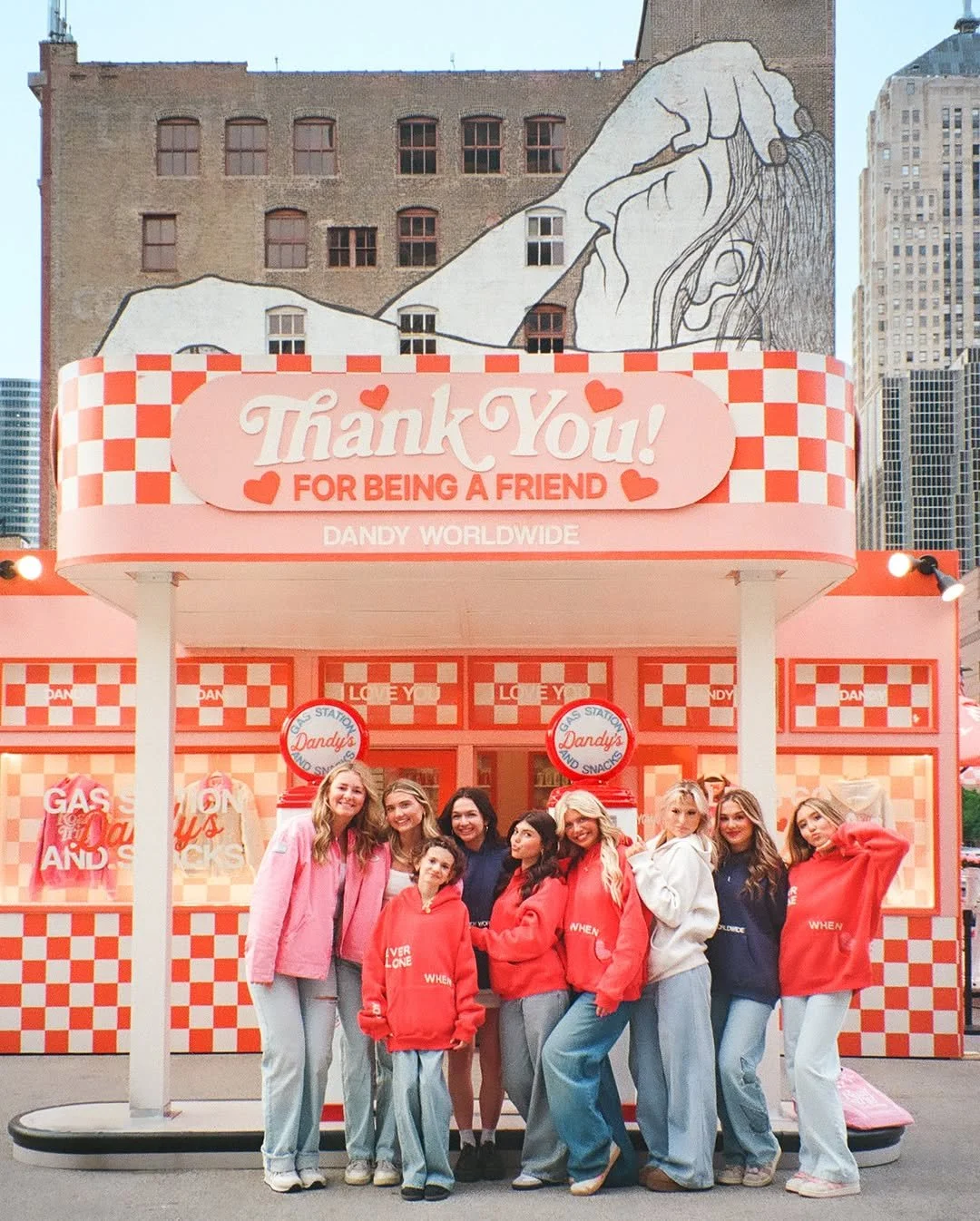
Experiential marketing campaign for Dandy Worldwide
Guerrilla marketing works when a brand earns attention through surprise, context, and participation—not media spend. The best guerrilla marketing examples turn an ordinary public moment into a reason to stop, try, talk, photograph, or act.
Below are 15 campaigns worth studying, plus the operational reality most “cheap stunt” articles skip: permits, permissions, staffing, fabrication, and production. At Evolve Activation, we build guerrilla and street-team programs that run safely, legally, and repeatedly—not just once for a video.
What Counts as Guerrilla Marketing?
Guerrilla marketing is an unconventional, high-impact activation designed to create attention in a public or unexpected setting. It often uses street teams, pop-ups, stunts, ambient installations, sampling, or participatory experiences.
It differs from a standard ad because the audience encounters it in real life. The goal is not just impressions. It is recall, trial, social sharing, and a reason to choose the brand later.
The strongest guerrilla marketing campaigns are not random stunts. They make the brand’s promise physical. Red Bull proves energy through extreme performance. IKEA proves functionality by putting furniture where people live and commute. A good activation gives people a story they can retell.
The test: If someone sees it, can they explain what the brand does—and why it matters—in one sentence?
15 Guerrilla Marketing Examples
1. Red Bull Stratos: Turn the Brand Promise Into an Event
In 2012, Red Bull sponsored Felix Baumgartner’s Stratos jump from the stratosphere. The stunt was livestreamed on YouTube, drawing more than 8 million concurrent viewers and making the brand’s “push limits” positioning impossible to ignore.
Why It Worked: Red Bull did not advertise an extreme event. It created one, then made the audience part of the broadcast.
What To Steal: Build the activation around a claim your brand can credibly make. For Red Bull, risk and performance were not decoration; they were the product story.
2. IKEA’s Subway Living Rooms: Demonstrate the Product in Context
IKEA has transformed transit spaces into furnished living rooms, letting commuters sit, browse, and experience products in a real-world setting. A Paris subway installation is one of the most-cited examples.
Why It Worked: The setting solved the product’s core objection. Instead of asking people to imagine a sofa in a small apartment, IKEA put one in front of them.
What To Steal: Put the product where the customer’s problem already exists. A food brand belongs near hunger. A commute brand belongs near transit. A dorm brand belongs on campus.
3. Volkswagen’s Piano Stairs: Make the Desired Behavior Fun
Volkswagen’s “Fun Theory” campaign turned a Stockholm subway staircase into working piano keys. The installation encouraged commuters to take the stairs instead of the escalator, and hidden cameras documented the response.
Why It Worked: It changed behavior through play, not instruction. People participated because the experience was enjoyable, then shared it because it was remarkable.
What To Steal: Give people a small, immediate reason to interact. A game, a challenge, a photo moment, or a useful reward beats a static brand message.
4. Frontline’s Giant Floor Sticker: Use the Environment as the Medium
Frontline placed an oversized floor sticker in Jakarta that made passersby look like pests viewed from above. The image spread because it was simple, visual, and instantly understandable.
Why It Worked: The execution required almost no explanation. The environment became the creative canvas.
What To Steal: Design for the location, not just the logo. The best ambient work makes the site part of the idea.
5. Coca-Cola’s Happiness Machine: Surprise People With Generosity
Coca-Cola’s “Happiness Machine” placed a vending machine that dispensed unexpected gifts, from flowers to pizza, to surprised students. The campaign turned a routine purchase moment into a shareable surprise.
Why It Worked: The brand gave people something to react to, not merely something to look at. The reactions became the content.
What To Steal: Make generosity visible. A giveaway becomes stronger when the recipient’s reaction is part of the activation.
6. Burger King’s “Whopper Detour”: Use Location to Create Action
Burger King’s “Whopper Detour” campaign encouraged app users to go to a McDonald’s location to unlock a one-cent Whopper through the Burger King app. The campaign used geofencing to turn a competitor’s footprint into a reason to download and use Burger King’s app.
Why It Worked: It connected a physical location to a measurable digital action. The stunt was provocative, but the mechanic was clear.
What To Steal: Give the activation a next step. A QR code, app download, coupon, sample redemption, or social prompt turns attention into data.
7. Netflix’s Fear Street in Santa Monica: Make the Fictional World Physical
For Netflix’s Fear Street, we helped bring the franchise’s horror world into Santa Monica with a public-facing activation designed to make the series feel immediate and participatory. We translated a screen-first property into a street-level experience people could encounter, photograph, and share.
Why It Worked: Entertainment brands win when fans can step inside the story. The activation gave people a reason to engage beyond watching a trailer.
What To Steal: Start with the fan behavior you want. Do you want people to take photos, enter a world, solve something, or share a reaction? Build the environment around that behavior.
8. Our Campus Guerrilla Marketing: Meet Students in Their Routine
Our Campus Guerrilla Marketing case study shows how street-level presence can introduce a brand where students already spend time. Google Pay partnered with us to increase awareness and drive student adoption across three major UK universities: King’s College London, the University of Nottingham, and the University of the West of England in Bristol.
Each campus pop-up used a high-traffic footprint staffed by our trained Brand Ambassadors. Students who downloaded Google Pay played a live digital spin-to-win game and received prizes instantly, while our team educated them on convenience, security, and everyday student use.
Why It Worked: The activation made adoption tangible. Students did not have to wonder what they would get; they could participate and receive value immediately.
What To Steal: Map the audience’s day before designing the activation. Class schedules, dining patterns, club events, and transit routes should shape the plan.
Guerrilla marketing is not “do something weird outside.” It is put the right brand moment where the right people already are.
9. Google Pay on Campus: Turn Trial Into Instant Reward
Our Google Pay campus program reached more than 59,000 students through in-person and promotional tactics and generated more than 1,000 Google Pay downloads across three campuses. It also delivered a 42% conversion rate among engaged students, according to our case study.
Why It Worked: We paired peer-to-peer education with an instant reward. We did not ask students to trust an app; we gave them a reason to try it on the spot.
What To Steal: For tech, finance, and subscription products, reward the action you actually need. Download, sign-up, first transaction, referral, or trial—make it immediate.
10. Monster Energy’s Fantasy Ruby Red: Make a Launch Impossible To Ignore
To launch Fantasy Ruby Red, Monster Energy created a 12-foot can bursting from the ground on Abbot Kinney Boulevard in Venice, California. The installation included an app-less augmented-reality experience featuring the can’s custom artwork, plus a VIP event with artist Pinky Taylor.
Why It Worked: The installation was bold enough to stop traffic, but the AR layer and creator event gave people more than one way to engage.
What To Steal: Pair a physical spectacle with a digital reason to participate. The installation earns attention; the interaction earns content and data.
11. Kopiko Focus Coffee in Los Angeles: Make Trial Immediate and Valuable
Kopiko USA launched its Focus Coffee product with a multi-day activation at a Mobil gas station in Westwood, Los Angeles. Students who showed a valid student ID and bought a $2.99 pack received up to $70 in free gasoline. Our case study reports that the activation gave away 9,000 gallons of fuel, valued at approximately $45,000.
Why It Worked: The offer was directly tied to purchase and trial. It gave students a practical reason to try the product, while creating a strong story around the giveaway.
What To Steal: Tie the incentive to the behavior that matters. A sample is good. A sample paired with a purchase, redemption, or measurable action is better.
12. Pocari Sweat Field Marketing: Build Familiarity Before Shelf Presence
Our Pocari Sweat field marketing program supported a Japanese beverage brand entering the U.S. market through field-level sampling and consumer engagement. We put the product directly into consumers’ hands in relevant settings.
Why It Worked: For an unfamiliar import, tasting and context matter. Field marketing lets consumers form an opinion before they see the product in a store.
What To Steal: Use guerrilla tactics to create familiarity before asking for a purchase. Awareness without trial is fragile; trial without context is random.
13. Dandy Worldwide’s Roadside Oasis: Turn a Seasonal Idea Into a Destination
We built Dandy Worldwide’s Roadside Oasis pop-up, turning a seasonal brand idea into a physical destination. We gave the brand a place people could visit, photograph, and talk about—not just an ad they could scroll past.
Why It Worked: A pop-up works when it gives the audience a reason to show up. The environment, product, and content moment need to reinforce one another.
What To Steal: Give the activation a destination feel. A clear reason to attend, a strong visual identity, and an easy shareable moment will outperform a generic branded booth.
14. Oishii at Farmers Markets: Sell Premium Through Experience
Our Oishii farmers markets activation brought a premium food brand into a setting where taste, freshness, and provenance could be experienced directly. We put the product in consumers’ hands at the moment they were already shopping for food.
Why It Worked: Premium products benefit from sensory proof. Farmers markets provided an audience already primed to care about quality and origin.
What To Steal: Match the channel to the claim. If your product’s advantage is taste, texture, freshness, or craftsmanship, let people experience it.
15. College Marketing Street Teams: Build Relevance, Not Just Reach
Campus guerrilla marketing works when it feels native to student life. Our approach uses street teams, sampling, games, ambassadors, and student partnerships to reach students in the places they already gather.
Why It Worked: Students notice brands that understand their routine. A useful giveaway, a well-placed activation, or a peer-led interaction can create familiarity faster than a broad digital campaign.
What To Steal: Hire and train people who can represent the brand credibly. A street team is not just extra staffing; it is the brand’s first impression.
What the Best Guerrilla Campaigns Have in Common
The best guerrilla marketing campaigns share five traits. They are not just creative ideas—they are built to earn attention, create participation, and produce a measurable result.
A Clear Brand Connection: The stunt must make the brand’s promise more believable, not merely more visible. Red Bull’s extreme positioning and IKEA’s functional design both translate directly into their activations.
A Real Audience Moment: Put the activation where the target audience already is: campus, transit, retail, events, or a cultural district. Our Google Pay campus program worked because it met students during their normal day.
Participation: Give people something to do, taste, play, win, photograph, or share. A static installation can earn attention, but participation creates a stronger memory.
A Measurable Next Step: Connect the experience to trial, redemption, app download, lead capture, or purchase. Our Google Pay activation paired engagement with an immediate download and reward.
Operational Discipline: Permits, staffing, fabrication, logistics, and contingency planning determine whether the idea survives contact with reality. We handle these details in-house.
The best guerrilla campaign is not the loudest idea. It is the one your audience can participate in, understand instantly, and remember later.
Guerrilla Marketing Ideas That Work
If you are planning a guerrilla marketing campaign, start with one of these formats:
Street-Team Sampling: Put trained brand ambassadors in high-traffic locations with a product trial and a clear call to action.
Campus Activation: Use student ambassadors, games, giveaways, and partnerships to reach students during their daily routine.
Ambient Installation: Turn a transit stop, storefront, park, or event space into a physical expression of the brand promise.
Pop-Up Experience: Create a temporary destination that gives people a reason to attend, participate, and share.
Interactive Stunt: Use a game, challenge, AR layer, or unexpected reward to earn participation.
Product-Drop Moment: Make a launch physical with an installation, sampling program, or creator event.
Cause-Driven Activation: Connect the brand to a community need through ActivateGOOD-style purpose-led programming.
The format matters less than the fit. A pop-up can be brilliant for a retail brand and wasteful for a B2B software company. A campus street team can be ideal for a beverage launch and wrong for an enterprise product with no student audience.
Permits and Legal Risk: The Part Nobody Posts About
A guerrilla activation is only as good as its paperwork.
Public property, private property, transit authorities, campuses, festivals, and city centers all have different rules. A brilliant installation can be shut down in minutes if it blocks access, creates a safety issue, lacks authorization, or violates a venue agreement.
We handle permitting in-house. That means we pressure-test the concept for buildability, budget, permitting, and on-the-ground reality before a dollar is spent. We also manage venue sourcing, permit navigation, vendor management, fabrication, transport, and day-of logistics.
Before approving any guerrilla marketing campaign, answer these questions:
Who Owns the Space? Public land, private property, campus grounds, and event venues require different approvals.
What Permits Are Required? Street closures, amplified sound, food sampling, structures, generators, alcohol, and photography each can trigger separate requirements.
Will the Activation Obstruct Access? Sidewalks, entrances, fire lanes, ADA paths, and emergency access cannot be compromised.
Who Is Staffing It? Brand ambassadors need training on the offer, brand story, safety protocols, data capture, and escalation procedures.
What Happens if It Rains, Gets Crowded, or Gets Shut Down? Build a contingency plan before launch day.
A guerrilla campaign should feel spontaneous to the audience. It should never be spontaneous to the operations team.
How To Brief a Guerrilla Activation
Use this sequence:
Define the Business Objective. Awareness, trial, leads, app installs, retail traffic, or cultural relevance.
Identify the Audience and Their Routine. Where are they already gathered, and what would make them stop?
Choose One Sharp Creative Idea. If you need three paragraphs to explain it, simplify it.
Design the Participation Mechanic. Decide what the consumer does, receives, shares, or buys.
Pressure-Test the Logistics. Confirm permits, staffing, fabrication, transport, weather, security, and contingency plans.
Set Measurement Before Launch. Agree on samples distributed, interactions, redemptions, leads, content captures, or sales impact.
Great ideas die in production. Ours do not.
Common Questions
What Is Guerrilla Marketing?
Guerrilla marketing is an unconventional activation designed to generate attention and engagement in a public or unexpected setting. It can include street teams, sampling, pop-ups, ambient installations, stunts, and interactive experiences.
Is Guerrilla Marketing the Same as Experiential Marketing?
No. Guerrilla marketing is usually a tactic; experiential marketing is the broader discipline of creating live brand experiences. A guerrilla activation can be experiential, but not every experiential program is guerrilla marketing.
How Much Does a Guerrilla Marketing Campaign Cost?
Cost depends on the format, number of markets, event days, fabrication, staffing, permits, transportation, and measurement. A focused street-team program can be more efficient than a large build, but permits and production quality still require budget.
Do Guerrilla Marketing Campaigns Need Permits?
Often, yes. Public spaces, campuses, transit areas, festivals, and private property can require authorization, insurance, approvals, or site-specific permissions. We manage permit coordination as part of our execution process.
What Makes a Guerrilla Campaign Successful?
A successful guerrilla marketing campaign has a clear brand connection, a relevant audience, a participation mechanic, a measurable next step, and disciplined operations. The best examples create a moment people want to talk about—and a reason to act.
Plan an Activation That Gets Noticed
Guerrilla marketing works when strategy comes first and spectacle follows. We build guerrilla, street-team, sampling, campus, and launch programs from strategy through execution, with permitting, staffing, logistics, and measurement handled by one team.
Planning a guerrilla campaign, sampling program, or street-team activation? We handle strategy through execution with one team. Tell us what you’re trying to do → Contact Us.
