
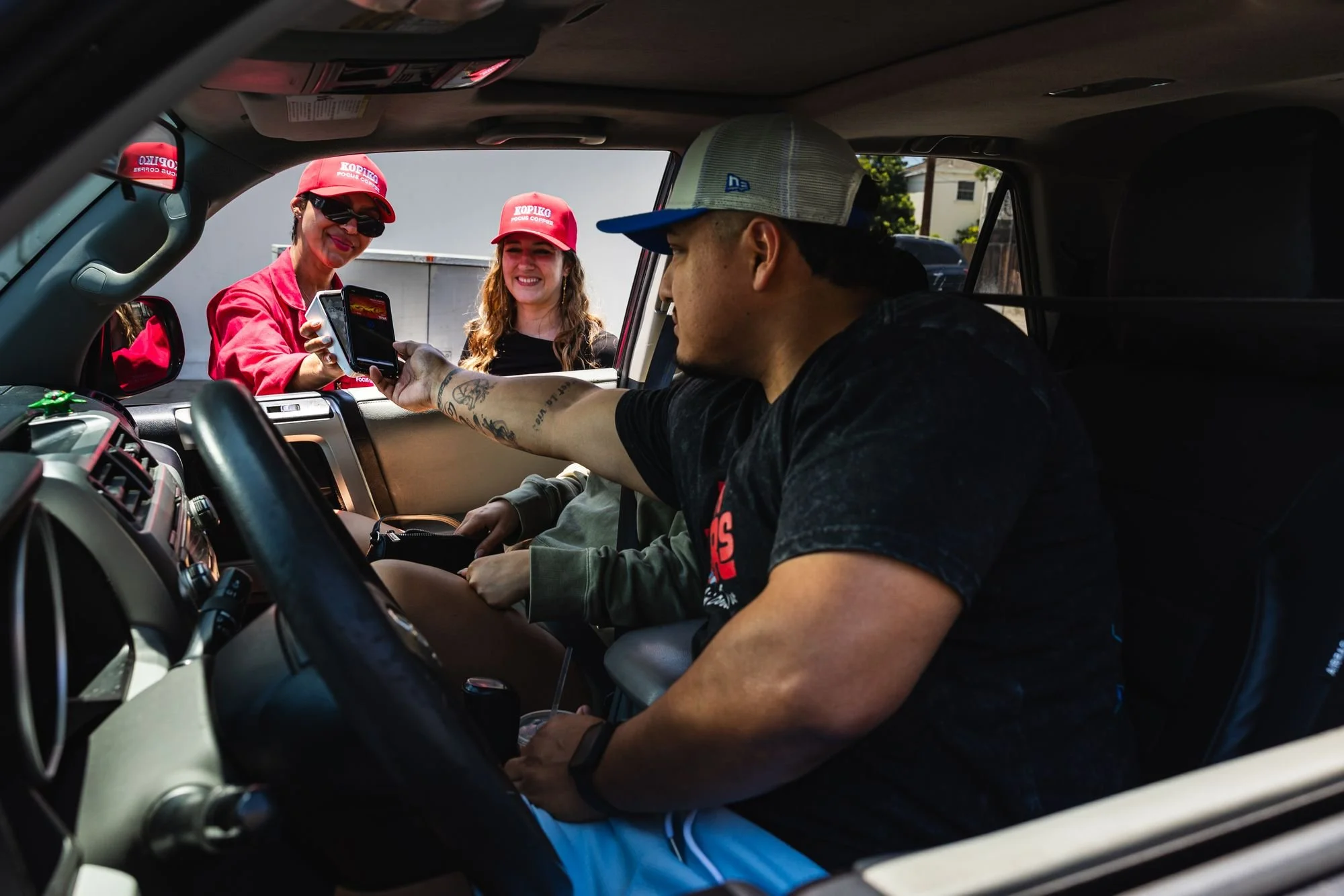
Brand ambassadors engaging with a consumer during the Kopiko activation.
Field marketing is marketing that happens where your audience already is: in stores, on campuses, at events, on streets, and in the moments before a purchase. It puts trained people and physical brand experiences in front of consumers, then measures whether those interactions create trial, awareness, leads, or sales.
It is not simply “handing out samples.” A strong field marketing program uses the right location, the right team, a clear message, and a measurable next action. For a new beverage, that may mean putting a cold sample into a runner’s hand after a race. For a tech brand, it may mean a campus street team driving qualified sign-ups. For a retailer, it may mean in-store demonstrations that turn browsers into buyers.
We use field marketing to make brands tangible. Digital advertising can create recognition. Field marketing creates a reason to try, remember, and act.
What is Field Marketing?
Field marketing is a face-to-face marketing discipline that takes a brand directly to consumers or business buyers in the places where they live, shop, work, train, travel, or make decisions. It can include product sampling, brand ambassador programs, retail demonstrations, street teams, campus activations, event marketing, mobile tours, and local sales support.
The “field” is the real world. The work happens outside a brand’s headquarters, media plan, or website: at a grocery store, festival, gym, stadium, campus, transit hub, trade show, or neighborhood event.
A useful way to think about it: field marketing is the operational layer of experiential marketing. It turns a strategy into trained people, product, permits, locations, conversations, data capture, and results.
At Evolve Activation, we build field programs from strategy through execution. That includes audience and market planning, creative and production, staffing and training, logistics, permits where needed, on-site management, and reporting. See our experiential marketing services for the full scope.
Field Marketing vs. Experiential Marketing
People often use “field marketing” and “experiential marketing” interchangeably. They overlap, but they are not the same thing. Experiential marketing is the broader creative discipline: designing an experience that makes people feel, understand, or participate in a brand. Field marketing is the delivery system that puts that experience into specific markets and consumer moments. A mobile tour is experiential; the trained team sampling product at each stop, capturing data, and supporting nearby retail is field marketing. A pop-up is experiential; the staff who greet visitors, explain the product, and convert interest into a purchase or follow are field marketing. The distinction matters because “cool experience” is not a strategy. A field program needs a commercial outcome.
Field Marketing vs. Sampling
Sampling is one of the most common field marketing tactics, but it is not the whole discipline.
Sampling puts a product into someone’s hands. Field marketing decides who receives it, where they receive it, what the brand ambassador says, what they are asked to do next, and how the brand measures the result.
A sample handed out with no context is a giveaway. A sample paired with a relevant moment, a short product story, a retail prompt, and a measurable follow-up is field marketing.
For example, a hydration drink may perform well at a fitness event, but the program should not stop at distribution. The team can explain when and why to use the product, offer a branded takeaway, invite a social follow, and direct consumers to a nearby retailer or online offer.
We cover the strategy behind trial in our guide to product sampling trends and why sampling still works.
Field Marketing vs. Experiential Mobile Marketing
Experiential mobile marketing is a field marketing format that travels. Instead of activating one fixed location, the brand takes a custom vehicle, trailer, pop-up, or mobile installation to multiple cities, venues, or retail partners.
It works when a brand needs geographic reach, a consistent brand experience, or a physical presence in markets where it does not yet have a store or major retail footprint.
A mobile program can include:
A branded vehicle or trailer that becomes a traveling product experience.
Sampling, demonstrations, games, photo moments, and influencer activations at each stop.
Retail, campus, festival, sports, and community-event appearances.
Local staffing, permitting, routing, logistics, and market-specific reporting.
The mobile format gives a brand scale. The field team gives it relevance. A vehicle without trained people, local planning, and a reason for consumers to engage is just expensive transportation.
Common Field Marketing Program Types
Field marketing is not one format. It is a set of tools that can be combined around one objective.
Product Sampling
Sampling introduces a product through direct trial. It is especially useful for food, beverage, beauty, wellness, household, and CPG brands because taste, texture, scent, and immediate use matter.
The strongest programs sample where the audience can act on the experience: near a retailer, at a relevant event, on a campus, or in a community where the product solves a real need.
Brand Ambassador Programs
Brand ambassadors are trained representatives who make the brand feel human. They explain the product, answer questions, create energy, encourage participation, and represent the brand’s tone in public.
A good ambassador does more than wear a branded shirt. They understand the product, the audience, the call to action, and the difference between starting a conversation and interrupting one.
Evolve recruits, trains, and deploys brand ambassadors, promotional talent, street teams, and trade show specialists through a nationwide staffing network.
Street Teams and Guerrilla Programs
Street teams take a brand into high-traffic or culturally relevant public spaces. They may distribute samples, promote an event, drive app downloads, collect leads, support a launch, or create a shareable moment.
Guerrilla marketing can be part of a field program, but it needs discipline. Permits, safety, brand fit, local regulations, and a clear measurement plan separate a smart activation from an expensive stunt.
Retail Demonstrations and In-store Support
Retail field marketing happens where purchase decisions are made. Demonstrators can educate shoppers, sample product, explain a promotion, answer questions, and encourage immediate purchase.
This is particularly valuable when a product needs explanation, has a new formulation, competes in a crowded category, or needs to convert shelf presence into basket sales.
Campus and Community Programs
Campus field marketing reaches students where they study, socialize, exercise, and make first-time brand decisions. Community programs reach local audiences through markets, runs, festivals, sports leagues, and neighborhood events.
These programs work because they meet people in a context that already feels relevant. A beverage brand at a fitness event has a clearer reason to be there than the same brand interrupting an unrelated commute.
Event and Sponsorship Activation
Event field marketing puts a brand inside a fan, consumer, or industry event. It can include a booth, sampling bar, interactive installation, lounge, product demo, or branded experience tied to a sponsorship.
The goal is not just visibility. It is engagement that leads somewhere: a trial, a social action, a lead, a retail visit, or a purchase.
How a Field Marketing Program Works
A field program succeeds or fails before anyone puts on a branded shirt. The process should be practical, not theatrical.
1. Define the Commercial Objective
Start with the outcome. Do you need trial, awareness in a new market, retail sell-through, qualified leads, social growth, event attendance, or purchase?
“Create buzz” is not enough. A useful objective sounds more like: “Drive trial among active 18-to-34-year-olds in five markets and support launch availability at nearby retailers.”
2. Choose Markets and Moments
Field marketing is most powerful when location and timing match the audience’s behavior. A runner needs hydration after a race. A student needs a convenient snack between classes. A shopper needs a reason to choose a new product at the shelf.
We look at audience density, venue fit, competitor presence, seasonality, retail proximity, permits, and the practical realities of moving people and product through a market.
3. Build the Experience Around One Job
Every field activation should have one primary job. Sampling may drive trial. A mobile tour may build awareness. A retail demo may convert purchase. A campus program may generate sign-ups.
Trying to accomplish every objective at once usually produces a cluttered experience and unclear reporting.
4. Staff and Train the Right People
Staffing is not a last-minute line item. The person representing your brand determines whether the interaction feels helpful, memorable, or forgettable.
A field team should know the product, the audience, the brand story, the call to action, and how to handle common questions. They should also know how to work quickly in high-traffic environments without making the experience feel transactional.
5. Handle the Unglamorous Operations
Permits, insurance, product storage, transportation, inventory, weather contingencies, site approvals, sanitation, and reporting all determine whether the program runs.
This is where many programs break. A beautiful concept cannot compensate for a team that arrives without product, a venue that denies access, or a sample that spoils in the heat.
6. Measure What Matters
Measurement should be agreed before launch. Depending on the program, useful metrics may include samples distributed, meaningful interactions, product trials, QR scans, sign-ups, social follows, content captures, retail referrals, redemptions, and sales where data is available.
A field program should produce evidence, not just photos. Evolve builds measurement into the program so clients can see what happened, compare markets, and improve the next flight.
When Brands Need Field Marketing
Field marketing is not right for every objective. It is most valuable when a brand needs physical proof, local relevance, or direct consumer action.
Launching in a New Market
A new brand cannot rely on awareness alone. Consumers need a reason to trust an unfamiliar product, especially in food, beverage, wellness, and beauty.
Field marketing lets people taste, touch, or try the product before they are asked to buy it. It also gives the brand a chance to explain what makes it different in plain language.
Supporting Retail Distribution
If a product is on shelf but not moving, field marketing can connect the shelf to the shopper. In-store demos, sampling, and local events give consumers a reason to look for the product and buy it.
This is especially useful for new SKUs, premium products, and categories where consumers need reassurance before switching.
Reaching a Hard-To-Find Audience
Some audiences do not respond to broad digital advertising. Athletes, students, parents, professionals, festivalgoers, and local communities each have specific places, routines, and moments where a brand can show up naturally.
Field marketing lets a brand meet those people in context rather than hoping an ad reaches them at the right time.
Creating Trial For a Product That Must be Experienced
Some products sell themselves after one interaction. A beverage needs to be tasted. A skincare product needs to be felt. A tech product needs to be used. A snack needs to be eaten.
When the product experience is the strongest argument, field marketing gives it a stage.
Building Local Momentum Around a National Campaign
A national campaign can create recognition, but field marketing makes it feel local. A brand can activate in the cities where its audience lives, support retail partners, show up at relevant events, and give consumers a direct reason to act.
Pocari Sweat: Field Marketing in Practice
Pocari Sweat came to Evolve to introduce its hydration water to U.S. consumers. The brand needed more than a logo at an event. It needed consumers to understand the product, try it, and begin building familiarity in a competitive beverage market.
We created a multi-market field marketing program across Los Angeles, San Francisco, and Houston. The program blended Japanese wellness culture with modern fitness trends through Costco activations, “Japanese Curious” events, Angels sports events, wellness activations, and high-heat street teams.
Brand ambassadors offered product samples and interactive hydration experiences. The program also used branded water bottles, towels, tote bags, and sweatshirts to extend the interaction beyond the event, while social strategies helped grow Pocari’s digital community.
The results show what a disciplined field program can do:
102 total event days across three markets.
232,081 samples distributed.
3,181,751 total event impressions.
10,601 increase in social media followers.
6,699 branded premiums distributed.
Read the full Pocari Sweat field marketing case study.
The lesson is simple: Pocari Sweat did not just buy impressions. It created repeated, relevant opportunities for consumers to try the product and form an opinion.
What a Field Marketing Agency Does
A field marketing agency turns a brand objective into a program that can actually run across markets, venues, and consumer moments.
At Evolve, that work includes:
Audience, market, and location strategy.
Creative concepting and production design.
Brand ambassador recruitment, training, and management.
Sampling logistics, product handling, and inventory control.
Venue sourcing, permits, transportation, fabrication, and on-site operations.
Retail, campus, event, and community partnerships.
Data capture, reporting, and program optimization.
Measurement planning tied to the client’s business objective.
The value is not a bigger team. It is fewer handoffs, fewer surprises, and a program that stays connected from strategy to post-event reporting.
How to Measure Field Marketing
Start with the action you want, then measure the steps that lead to it.
For a sampling program, track samples distributed, meaningful conversations, product trials, QR scans, coupon redemptions, retail referrals, and repeat purchase where data is available. For a lead-generation program, track qualified leads, cost per lead, conversion rate, and pipeline created. For an awareness program, track reach, impressions, engagement, content captures, social growth, and brand-recall research where appropriate.
Do not treat every sample as a success. A sample is only useful when it reaches the right person, in the right context, with a clear reason to act.
A useful rule: every field program should have one primary KPI, two or three supporting KPIs, and a plan for what the brand will do differently after the first market.
Common questions
What is Field Marketing in Simple Terms?
Field marketing is marketing that happens in person, in the places where consumers or business buyers make decisions. It includes sampling, brand ambassadors, street teams, retail demos, campus programs, events, and mobile tours.
Is Field Marketing the Same as Experiential Marketing?
No. Experiential marketing is the broader practice of creating brand experiences. Field marketing is the in-market execution layer that puts those experiences in front of specific audiences and measures their impact.
What Does a Field Marketing Agency Do?
A field marketing agency plans, staffs, produces, executes, and measures in-person brand programs. That can include market selection, creative, staffing, training, permits, logistics, sampling, retail support, and reporting.
When Should a Brand Use Field Marketing?
Use it when you need product trial, local market awareness, retail support, qualified leads, campus reach, event engagement, or a direct connection with a hard-to-reach audience.
Is Product Sampling Field Marketing?
Sampling is a field marketing tactic, but field marketing is broader. A sampling program becomes field marketing when it includes audience targeting, trained staff, a brand message, a call to action, and measurement.
Planning a Field Program?
Field marketing works when strategy, staffing, logistics, and measurement move together. We build programs that put the right product in front of the right people, in the right market, with a clear reason to act.
Planning a sampling program, mobile tour, launch, or retail activation? We handle strategy through execution with one team. Tell us what you’re trying to do → Contact Evolve Activation.
