
Brand Activation Ideas for 2027: 30 Concepts by Budget and Goal
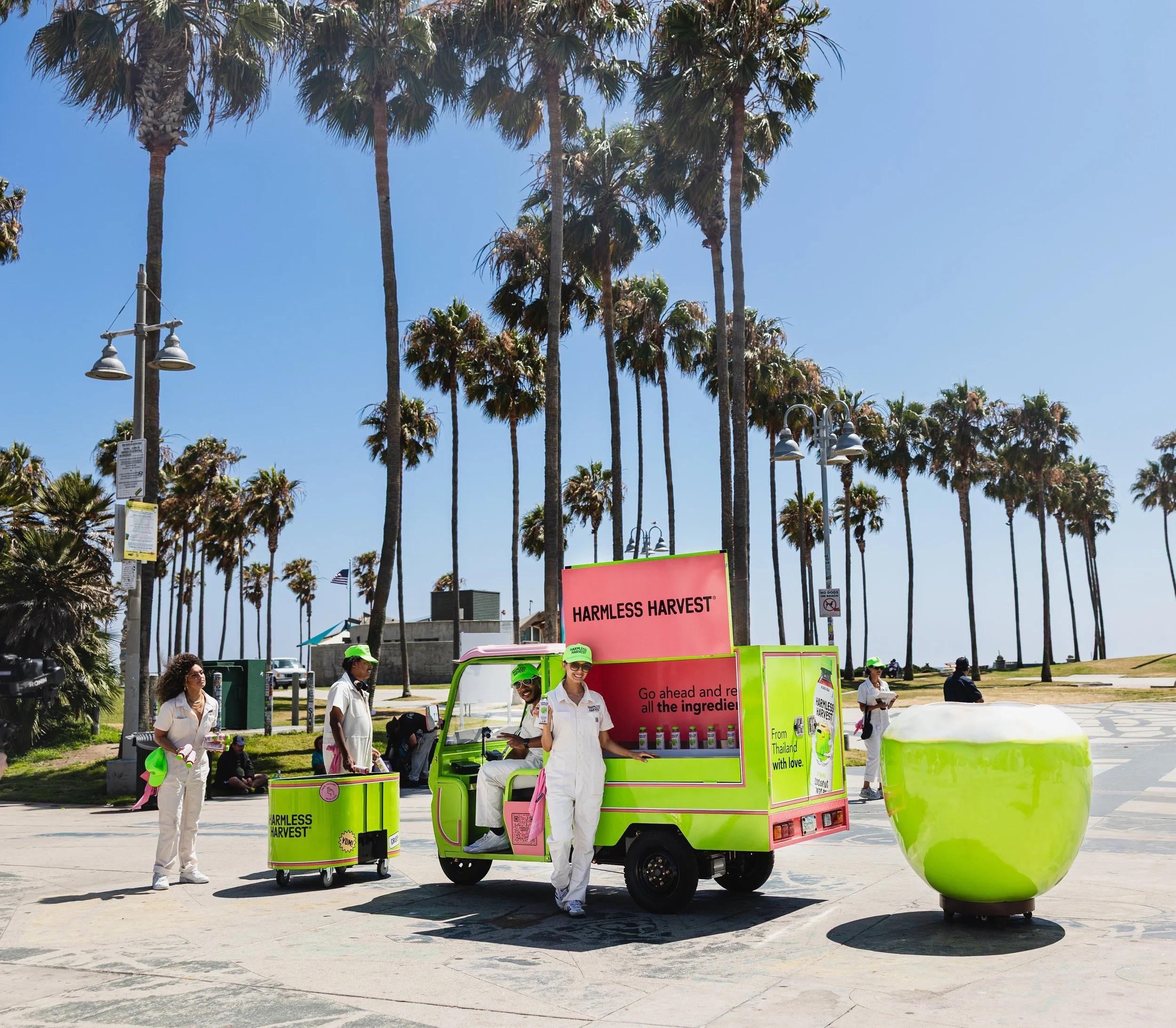
Brand activation for Harmless Harvest.
The best brand activation ideas start with a business goal, not a production budget. If you want awareness, you need a concept people notice and remember. If you want trial, you need to get the product into their hands. If you want conversion, the next step needs to be clear before the activation opens. That is where many campaigns go wrong. They spend heavily on the footprint and leave the audience with no real reason to engage.
At Evolve Activation, we build experiences around what the campaign needs to achieve, whether that means sampling a new product, creating a mobile tour, bringing a sponsorship to life or turning a retail location into a destination. The 30 brand activation ideas below are organized by goal and budget, with practical concepts you can adapt for a local activation, national tour or major launch.
Some are lean and operationally simple. Others require more production, staffing and planning. None rely on a generic photo wall or branded giveaway doing all the work.
How to Choose a Brand Activation Idea
Start with the goal, not the spectacle.
An awareness activation needs reach and memorability. A trial activation needs product interaction. A conversion activation needs a clear path to purchase, sign-up or lead capture. A culturally relevant activation needs a credible connection to a community, moment or conversation.
Budget matters, but it does not determine whether an idea works. A tightly managed street team can outperform an expensive installation if the audience, message and follow-up are stronger.
Before developing the creative, ask what you want people to do, where the right audience already spends time, what they get from participating and how you will know whether the activation worked.
Evolve starts in this order because a strong idea still needs to work in the real world. Location access, permits, staffing, fabrication, travel, timing and reporting all shape the final experience. Our experiential marketing services bring strategy, creative, production and execution together from the beginning.
A memorable activation is not automatically an effective activation. The idea has to give people a reason to engage and the brand a reason to invest.
Brand Activation Ideas for Awareness
Awareness activations are designed to make a brand visible, recognizable and worth talking about. They work best when the concept is simple enough to understand quickly but distinctive enough to remember later.
1. Street-Level Product Reveal
Take a new product into a high-footfall location with a compact branded setup and a trained team. The experience might include a product demonstration, sample, short challenge or reveal moment that gives passersby a reason to stop.
The setup does not need to dominate the space. It needs to communicate what is happening within seconds. Evolve can manage the creative development, location planning, production and staffing so the audience sees one clear idea rather than a collection of disconnected elements.
2. Branded Sampling Route
Build a sampling route around moments when the product solves a real need. An energy drink might appear during an afternoon commute, while a snack brand could meet consumers at a market, campus or sports event.
The team should do more than hand out products. Brand ambassadors need a short, natural explanation that connects the product to the moment and makes the interaction feel personal.
For food and beverage brands, Evolve’s CPG experiential marketing services can bring together sampling, retail activations, mobile tours and product experiences.
3. Moving Message Team
Use a trained team on foot, bikes or a branded vehicle to create repeated exposure in a defined area. This can work well for launches, location openings, retail promotions and event build-up campaigns.
The mistake is treating the team as walking signage. Give them a clear action, prop or product interaction that makes the campaign recognizable and gives people a reason to engage.
The format is especially useful when the campaign needs flexibility. Staff can move toward busy areas, adjust the conversation and report what people are responding to throughout the day.
4. “Find It First” Product Drop
Create a product discovery moment in a neighborhood, campus, retail area or event space. Participants might receive an early product sample, access to a limited experience or an invitation to a launch moment.
The idea works when the discovery feels genuine. If the audience can tell that the scarcity is artificial, the activation becomes another giveaway with a countdown clock.
Keep the rules easy to understand. People should know what they are looking for, where to go and what they receive without reading a long set of instructions.
5. Pop-Up Product Window
Use a storefront, retail frontage, lobby or temporary structure to create a short-term product display. The space can be simple, but it should offer more than a branded backdrop.
A scheduled demonstration, product specialist or rotating activity can give people a reason to return. Our pop-up activation services can support the concept from site selection and production through staffing and execution.
For more planning guidance, see our guide to planning pop-up events. A pop-up should feel temporary and special, but it still needs a practical operating plan.
6. Mobile Brand Experience
A mobile experience lets the brand reach several neighborhoods, events or markets through one recognizable format. Each stop should feel connected to the wider campaign while still making sense in its local setting.
The route should be based on audience behavior, not just a list of major cities. Evolve can support mobile programs with location scouting, permits, tour logistics, staffing, training, transportation and reporting.
A mobile experience also creates opportunities for local adaptation. The core concept stays consistent, while the team can adjust the message, timing or activity to suit each location.
7. Useful Brand Service
Give people something they genuinely need. A brand might offer phone charging, sunscreen, hydration, product care, refreshments or a place to take a break.
The service needs to connect naturally to the brand. A random amenity with a logo attached will not create much meaning. The usefulness brings people over; the brand experience gives the interaction a reason to last.
This idea is particularly strong for sports, music, travel and outdoor programs. The brand becomes part of the occasion by making the audience’s day easier.
8. Visual Takeover With a Human Layer
A temporary visual takeover can attract attention, but the space should include people who help visitors understand what is happening. Staff can guide a demonstration, invite participation, answer questions and manage the flow around the installation.
Without that human layer, the experience may look impressive in photographs but fail to hold attention in person. Our team can develop the experience and staff it with people who understand the interaction, not just the script.
The staff should be briefed on the creative idea, the product message and the practical details of the space. That is how a large visual moment becomes a working brand experience.
9. ZOA Venice Pop-Up
ZOA’s Venice Beach activation used a strong location, a highly visible product experience and an environment built for participation. Evolve created a one-day launch for ZOA’s limited-edition Cherry Limeade flavor, combining a custom tiki bar, roller skaters, a plank challenge and a 20-ton sand sculpture.
The experience worked because the spectacle connected directly to the product and the brand’s energetic identity. It also gave people multiple ways to engage, from sampling and competition to social content.
The useful lesson is not to copy the exact format. It is to choose a location that already supports the brand’s personality, then design the interaction around how people behave there. See the ZOA Energy pop-up activation.
10. Public Product Challenge
Create a challenge that people can understand quickly and that others enjoy watching. It could involve speed, memory, balance, creativity or product knowledge.
The challenge should feel inviting rather than intimidating. Staff need to explain the rules clearly, encourage participation and keep the experience moving when a crowd forms.
A good challenge also gives the audience something to talk about after the event. The activity does not need to be complicated. It needs a clear payoff and a reason to connect the result back to the brand.
How Experiential Marketing Ideas Support Different Goals
Experiential marketing ideas work best when they are tied to a specific audience action. A sampling activation may be designed to drive trial, while a mobile tour may focus on awareness across several markets. A retail demonstration can support both product education and conversion.
The format should follow the goal. Do not build a large experience simply because the campaign needs attention. Choose the smallest format that can create the required interaction, then invest in the staffing, training and follow-up needed to deliver it properly.
A strong concept also leaves room for real-time decisions. Audience behavior, weather, traffic, venue rules and product demand can all change the way an activation performs. The production plan should be firm enough to protect the experience and flexible enough to respond.
Brand Activation Ideas for Trial
Trial activations reduce uncertainty. They allow people to taste, test, touch, compare or use the product before deciding what they think.
11. Targeted Sampling Station
Set up a sampling team where the audience already has time to engage. Farmers markets, fitness events, campuses, retail centers and community gatherings may all work, depending on the product and audience.
The goal is not simply to distribute as many units as possible. A better program considers who sampled, what questions came up, how people responded and whether the interaction led to a store visit or another action.
The staffing plan matters here. A trained team can manage the queue, keep the interaction moving and adjust the conversation based on the person standing in front of them.
12. Two-Product Comparison
Let people compare two flavors, formats or product versions. Keep the interaction simple and ask for an easy response, such as choosing a favorite or describing the difference.
The comparison gives the team a natural reason to explain the product. It also provides useful feedback that can inform future messaging, packaging or retail strategy.
The experience should not feel like a formal research session unless that is the campaign’s purpose. People should feel invited to share an opinion, not tested on the correct answer.
13. Sample With a Useful Takeaway
Pair the product sample with something people can use later. A recipe card, serving suggestion, routine guide or comparison card can help the product stay relevant after the event.
The takeaway should solve a small problem. A branded item that has no practical use will not extend the experience beyond the venue.
This format is especially useful for products that require explanation. A clear takeaway can show people how to use the product, where to buy it or what to pair it with.
14. Retail Takeover
Create a staffed product experience inside or near a retail location. The team can demonstrate the product, answer questions and direct interested shoppers to the correct shelf or checkout point.
This format shortens the distance between trial and purchase. It also gives the brand a chance to observe objections and questions while people are close to making a decision.
The retail team and activation team should agree on the operating plan before launch. Stock, replenishment, sampling rules, access, reporting and escalation all need clear owners.
15. Dandy Roadside Oasis
Dandy Worldwide’s roadside oasis pop-up shows how a seasonal environment can turn a product moment into a destination. The experience gave people a reason to stop, spend time and connect the brand with a summer setting.
The takeaway is simple: trial does not have to feel like a handout. When the environment gives people a reason to stay, the product gets more attention and the brand has more time to tell its story.
The activation also shows why the setting matters. A roadside stop, beach location or summer environment can become part of the product story when the creative, production and staffing all support the same feeling. Explore the Dandy Worldwide roadside oasis pop-up.
16. Guided Product Lab
Create a compact demonstration space where people can test a product through a short sequence. This works well for beauty, technology, food preparation and products with multiple features.
Keep the experience focused. A long demonstration may educate one visitor while losing everyone waiting behind them.
The staff should be able to adjust the explanation. Some people need a quick answer; others want to understand how the product works in detail. The best product specialists know when to explain, when to demonstrate and when to let the visitor try.
17. Tasting Menu or Trial Bar
Offer a curated tasting sequence instead of an open-ended sample table. Give each product a role and explain the order in plain language.
This format makes the experience feel intentional, particularly for premium food and beverage brands. It also helps the team collect more useful feedback than a general question such as, “Did you like it?”
The setting should support the product rather than overpower it. Premium does not have to mean elaborate. It can mean thoughtful pacing, clean presentation and knowledgeable staff.
18. Product Discovery Tour
Take the brand through several markets using a consistent discovery format. Each stop could include product education, trial, a purchase path and content capture.
The route should be planned around audience behavior, not just city names. A tour can look impressive in a presentation and still underperform if the stops do not match where the audience actually spends time.
Evolve can coordinate the moving parts behind the experience, from tour logistics and vendor management to staffing, training and market reporting. That keeps the consumer experience consistent without making every market feel identical.
19. Fitness or Performance Trial
Place the product inside an activity that naturally demonstrates its benefit. A beverage might support a fitness class, while a technology product could be tested through a timed challenge or performance demonstration.
The product should improve the activity rather than interrupt it. If the audience has to stop what they came to do, the activation will feel like an obstacle.
This concept works best when the brand has a credible role in the setting. The connection should be clear before the first product interaction.
20. Product Launch Experience
A launch experience should make the product feel new without forcing people through a long explanation. Give the audience a quick way to encounter the product, understand the key benefit and decide whether they want to explore further.
Monster Energy’s Fantasy Ruby Red campaign is a useful example of how a launch can combine product identity, visual energy and social participation. The format made the product feel like an experience rather than another item on a shelf.
The lesson is to build the launch around what makes the product distinctive. If the audience cannot explain what is new after the interaction, the experience needs a clearer message. See the Monster Energy Fantasy Ruby Red activation.
A sample is not the strategy. It is the first step in a trial journey that should lead somewhere.
Brand Activation Ideas for Conversion
Conversion activations make the next step obvious. That might be a purchase, sign-up, booking, app download, qualified lead or store visit.
21. QR-Led Offer Station
Use a clear offer, landing page or sign-up incentive to connect the physical experience with a digital action. The QR code should not be hidden in a sea of branding.
Staff should explain what happens after the scan and how long the process takes. People are more likely to participate when the value is obvious.
The landing page must work properly on a phone. If the digital step fails, the live team receives the blame even when the issue sits elsewhere.
22. Pop-Up Consultation Desk
Offer short, useful consultations with a trained team. This could work for beauty, technology, financial services, education or other products where people benefit from individual guidance.
The conversation should solve a specific problem rather than become a generic sales pitch. Capture only information the follow-up team can use.
Privacy and consent need to be part of the design. People should know what they are signing up for and who will contact them afterward.
23. Event Lead-Generation Lounge
Create a calmer space where qualified prospects can have a focused conversation away from the noise of the main event floor. Staff should use an agreed qualification process and record the next step.
A badge scan alone is not a conversion strategy. The team needs to know what makes a lead useful and how the handoff will work after the event.
The form should support the conversation rather than interrupt it. Ask only questions that will affect follow-up.
24. Interactive Technology Demonstration
An interactive technology experience should help people understand one clear product benefit. It should not exist simply because the campaign deck needs something described as “immersive.”
Snap activations provide a useful reference for using participation to demonstrate a technology product. The audience should be able to see what the product does by taking part.
Always plan a backup for connectivity, battery, device or software issues. The experience must continue even when the technology does not cooperate.
25. Retail Fitting Experience
A fitting experience can help customers compare products, receive guidance and understand what makes one option right for them. This works particularly well for eyewear, apparel, beauty and other products where personal choice influences the purchase.
Sunglass Hut’s pop-up work shows how a high-touch setting can support product discovery and retail engagement. The concept relied on personalization, atmosphere and trained interaction rather than simply placing more products on display. Explore the Sunglass Hut high-touch shopping experience.
The staff member matters as much as the display. A product specialist who listens can move someone from browsing to buying without making the interaction feel aggressive.
26. Appointment-Setting Activation
For products with a longer sales cycle, the goal may be a scheduled conversation rather than an immediate transaction. Give attendees a simple way to book a time while the interaction is still fresh.
Do not collect leads that nobody will follow up with. The activation and sales teams need to agree on ownership before the first shift begins.
Team members should know what information to collect, what promise to make and how quickly the next contact should happen.
27. Multi-Market Retail Conversion Tour
Combine mobile engagement, retail placement and digital offers across several markets. Each location should have a defined conversion path and a reporting method that links activity to outcomes.
This format requires close coordination between staffing, production, retail teams and the client’s sales or ecommerce teams. Without that connection, the campaign may generate attention but lose the commercial opportunity.
Use the same core reporting framework across markets. Local teams can add useful observations, but the main measures should remain consistent.
Sponsorship Activation Ideas for Cultural Relevance
Cultural relevance is not a logo placement. It is a reason for the brand to participate in a moment people already care about.
28. Sponsor Utility, Not Signage
At a festival, sports event or community gathering, provide something attendees genuinely need. Water, charging, shade, transport support, product care or recovery services can all create a more useful sponsorship presence.
The brand should make the utility easy to recognize without turning it into an obstacle course of messaging. An overbuilt sponsor village can feel like an advertising mall.
The best utility is visible, easy to access and properly staffed. If people cannot find the service or have to wait too long, the good idea quickly becomes frustrating.
29. Community-Led Creative Platform
Work with local creators, athletes, artists or community organizations to shape the activation before production begins. Give them a meaningful role in the idea, not just a scheduled appearance.
This can create stronger cultural credibility than hiring a recognizable name and placing them beside a branded wall. It also requires more listening and less control from the brand.
Set clear boundaries around the brand’s role, but do not script every detail. Audiences can tell when community participation is genuine and when it is only being used as decoration.
30. Brand Experience Built Around a Shared Passion
Build the activation around something the audience already enjoys, such as sport, music, food, beauty, travel or gaming. The brand should make the moment better rather than interrupting it with a sales message.
The experience might include a live demonstration, creator collaboration, product trial, competition or access to something normally unavailable. The format matters less than the connection between the brand and the audience’s existing interest.
Evolve can help turn that connection into a complete campaign, from strategy and creative through production, staffing, logistics and measurement.
Event Marketing Ideas by Budget
Event marketing ideas do not need to be expensive to be effective. A focused street team, product demonstration or useful service station can work well when the audience and location are carefully selected.
Lean programs usually benefit from fewer locations and better preparation. Concentrate the budget on the right staff, a clear interaction and a simple way to measure what happened.
Mid-range programs can support custom environments, multi-day operations, retail partnerships, content capture or several locations. The additional production should improve the audience experience or the campaign’s ability to reach its objective.
Large-scale programs may include mobile tours, sponsorship activations, product launches or multi-market campaigns. The higher budget should create more reach, stronger production or better measurement—not simply a larger footprint.
The budget should cover the complete operating model, not only the creative build. Staffing, training, travel, permits, fabrication, storage, transportation, technology, insurance, content capture, measurement and contingency all affect the final cost.
A small activation can become expensive when the team is asked to cover too many locations or long operating hours. A larger activation can become inefficient when production is designed before the audience journey is clear.
What Is Overdone in Brand Activations?
The Generic Photo Wall
A photo wall is not an activation strategy. Add a reason to participate, a useful product interaction or a changing visual element that gives people something to do.
If the only action is standing in front of a logo, the experience will be forgettable as soon as the photo is posted.
The Logo-Covered Giveaway
Branded merchandise works when it is useful, desirable or connected to the campaign. It does not work simply because the logo is large.
Give people something that supports the product or experience. Otherwise, the brand is paying to put another disposable item into circulation.
The Vague “Immersive” Room
Before approving an immersive build, define what the visitor does, feels and remembers. A room filled with screens is not automatically immersive.
The experience needs a clear beginning, middle and end. It also needs staff who can guide people without interrupting the atmosphere.
The QR Code With No Value
A QR code is only useful when the action behind it has a clear benefit. Tell people what the scan provides and how long it takes.
“Scan to learn more” is weak. “Scan for your personalized product recommendation” gives people a reason to participate.
The Celebrity Appearance Without a Role
A celebrity can attract attention, but the appearance should serve the experience. Give the person a meaningful role in the demonstration, conversation, performance or community program.
If the celebrity simply stands beside a branded wall, the audience may remember the person and forget the brand.
The Oversized Footprint With No Staffing Plan
A beautiful build cannot answer questions, manage queues or qualify leads. The staffing model should be designed alongside the creative concept.
Plan for breaks, late arrivals, shift changes, training, escalation and peak traffic. The audience experiences the operation, not the production schedule behind it.
Great ideas die in production when the staffing, logistics and audience journey are treated as afterthoughts.
How Should You Budget for an Activation?
Budget for the complete operating model, not only the creative build. Include staffing, training, travel, permits, fabrication, storage, transportation, technology, insurance, content capture, measurement and contingency.
A small activation can become expensive when the team is asked to cover too many locations or long operating hours. A larger activation can become inefficient when production is designed before the audience journey is clear.
Ask for a budget model that shows what changes as the program grows. More markets, longer hours and additional staffing should have clear cost and operational consequences.
The right production partner will challenge the idea where necessary. That is not a creative limitation. It is how you protect the experience from avoidable problems once the campaign goes live.
FAQ
What are brand activation ideas?
Brand activation ideas are campaigns or experiences designed to create a direct interaction between people and a brand. They can include sampling, pop-ups, product demonstrations, tours, sponsorship experiences, retail programs and community activations.
The strongest ideas connect a clear objective with a specific audience action, such as trying a product, sharing content, visiting a store or submitting a qualified lead.
What is the difference between experiential marketing ideas and brand activation ideas?
Experiential marketing is the wider discipline of creating memorable brand experiences. Brand activation usually refers to a campaign designed to prompt a measurable audience response.
The terms overlap, and many experiential marketing ideas are brand activations. The practical difference is the next step: an activation should make clear what the audience is being invited to do.
What are good event marketing ideas for a limited budget?
Good low-budget event marketing ideas focus on one audience, one location and one clear interaction. Examples include targeted sampling, a moving message team, a product challenge, a useful service station or a small retail demonstration.
Keep the footprint controlled and invest in prepared staff rather than unnecessary decoration. A simple activation with strong execution usually beats a large setup that feels empty.
How do you measure brand activation events?
Measure the actions that match the campaign goal. Awareness programs may track qualified reach, interactions and content activity. Trial programs may track samples, demonstrations and product feedback. Conversion programs may track purchases, sign-ups, bookings or qualified leads.
Set the measurement plan before the activation begins. Otherwise, teams often report easy numbers that do not explain whether the program worked.
What are strong sponsorship activation ideas?
Strong sponsorship activation ideas give attendees a useful reason to engage beyond seeing a logo. Shade, charging, refreshments, product trials, recovery spaces, creator-led programming and community support can all work when they fit the event and brand.
The activation should contribute to the event rather than interrupt it. That is the difference between being present and being relevant.
Plan the Right Activation
A strong activation starts with a clear goal, a realistic budget and a team that can deliver the experience consistently. Evolve Activation brings strategy, creative, production, staffing, logistics and measurement together so the idea works beyond the presentation deck.
Planning a sampling program, mobile tour, launch or sponsorship activation? We handle strategy through execution with one team. Tell us what you’re trying to do →
