Brand Activation Strategy: How to Turn a Big Idea Into a Real-World Experience
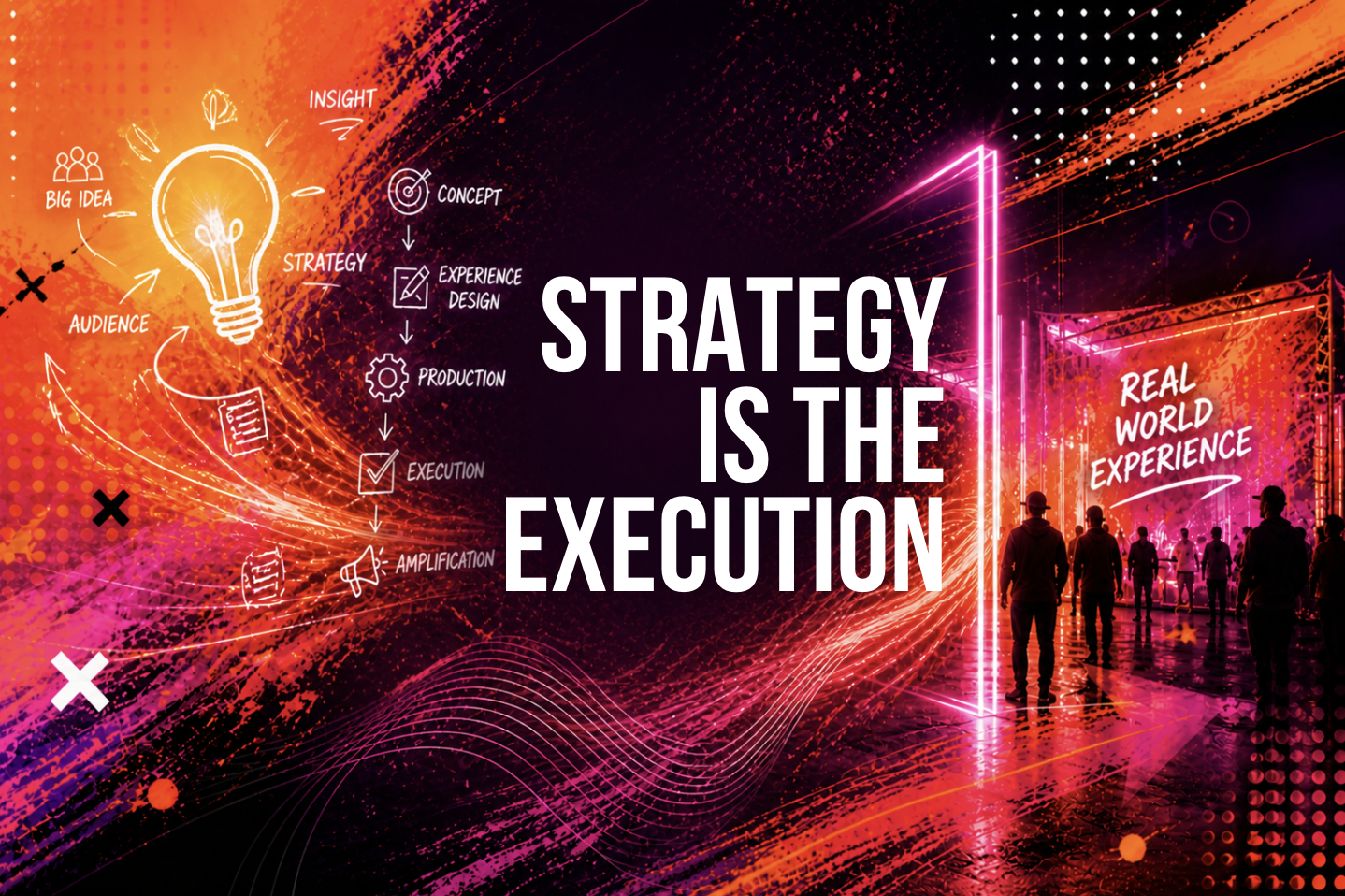
Big ideas are easy. Everyone has them. But in experiential marketing, the brands that win aren’t the ones with the most creative decks—they’re the ones who can execute.
That’s what a brand activation strategy actually does. It’s the bridge between a concept that sounds exciting in a room and an experience that stops people in the real world.
This post breaks down exactly what goes into building one—and why strategy is what separates a forgettable setup from a moment people talk about.
What Is a Brand Activation Strategy?
A brand activation strategy is the system that turns a creative idea into a physical, scalable, measurable experience—without losing what made it special in the first place.
It answers the questions most brands skip:
Where does this idea actually live in the real world?
Who is it for—and why would they stop?
What do we want people to feel, do, or share?
How will this be produced, staffed, and scaled?
What makes it memorable—not just visible?
Without a clear strategy, even well-funded activations become overbuilt but underwhelming—beautiful in theory, directionless in execution. Strategy is what gives creativity somewhere to go.
The Biggest Mistake Brands Make With Activations
Most brands start in the wrong place.
They start with: “What would look cool?”
Instead of: “What should this experience actually do?”
A strong experiential marketing strategy starts with intent. Drive trial? Build awareness? Create shareable content? Launch something new? Change how someone feels about your brand?
The same idea, executed with different intent, becomes a completely different experience. Strategy doesn’t limit creativity—it gives creativity direction.
The 5 Layers of a Strong Brand Activation Strategy
The best activations aren’t accidents. They’re built across five layers—each one shaping every decision that follows.
1. Audience Clarity
You’re not building for “everyone.” You’re building for a specific person, in a specific moment, in a specific place.
Where are they? What are they doing? Why would they stop? Great activations meet people where they already are—physically and mentally—rather than asking them to meet the brand halfway.
2. The Role of the Experience
Every activation needs a job. Is it a sampling engine? A content machine? A PR moment? A community touchpoint?
The strongest activations do multiple things—but they’re designed around one core role. That clarity drives every decision that follows, from footprint size to staffing to what you measure at the end.
3. Interaction Design
This is where most activations fall apart. If someone doesn’t know what to do within three seconds, they keep walking.
Strong interaction design answers: What draws someone in? What happens once they engage? What do they leave with—physically, emotionally, or digitally? Good activations are seen. Great ones are experienced.
4. Production Reality
This is where strategy gets real. Can the concept be built within budget? Can it travel across markets? Can it handle real crowds and be staffed effectively?
The best experiential marketing strategies are designed with production in mind from day one—not retrofitted later. Nothing kills a great idea faster than realizing it can’t actually be executed.
5. Built-In Amplification
If your activation only lived in the footprint, it didn’t reach its full potential. Modern brand activations are designed to travel: social content, press moments, influencer integration, repeatable formats across cities.
The experience isn’t just for the people who were there—it’s for everyone who sees it afterward.
From Idea to Execution: Where Strategy Makes the Difference
Two agencies can have the same idea. One becomes a forgettable setup. The other becomes a headline.
The difference is strategy and execution working together—from the first brief to load-in. That means designing for real environments, building for real people, and producing with teams who understand both creativity and logistics.
That’s where experiential stops being marketing and becomes something people actually remember.
What a Great Brand Activation Actually Feels Like
You know it when you experience one. It feels effortless (even though it isn’t), intentional in every detail, alive rather than static, and worth stopping for.
It doesn’t feel like a booth. It feels like a moment.
Those moments don’t happen by accident. They’re the result of a strategy that was clear from the start—and an execution team that knew how to bring it to life.
Why Brand Activation Strategy Matters More Than Ever in 2026
Attention is harder to earn—and faster to lose. People are surrounded by activations, events, and experiences competing for the same few seconds of their day.
Which means brands can’t just show up. They have to show up well.
A strong brand activation strategy ensures:
Ideas translate into real-world impact—not just real-world presence
Budgets are used with intention, not optimism
Experiences actually connect with the people they’re built for
Moments build momentum that extends beyond the event itself
Ready to Build Something That Actually Works?
If you’re planning your next activation, the question isn’t just “what’s the idea?”—it’s “what’s the strategy behind it?”
We help brands build experiences that don’t just look good in a deck—they work in the real world, connect with real people, and create momentum that lasts beyond the footprint.
👉 Let’s talk about your next activation